Thanksgiving is Thursday, November 26 this year, which gives most of us about three weeks of November lessons before the break. If you are looking for Thanksgiving songs for elementary music class, or a short Thanksgiving piece for your elementary choir, this is the list I wish I had the one year I taught elementary general music.
Every song below is either a traditional song you can teach by rote or a published octavo I checked on the publisher's own product page, with a link so you can see the score preview and hear a recording before you order. I have added a few teaching notes for each one, the same kind of notes I would scribble on a sticky note for a colleague down the hall.
First up is my own Thanksgiving song, and it is free.
Turkey In My Belly (free reproducible PDF)
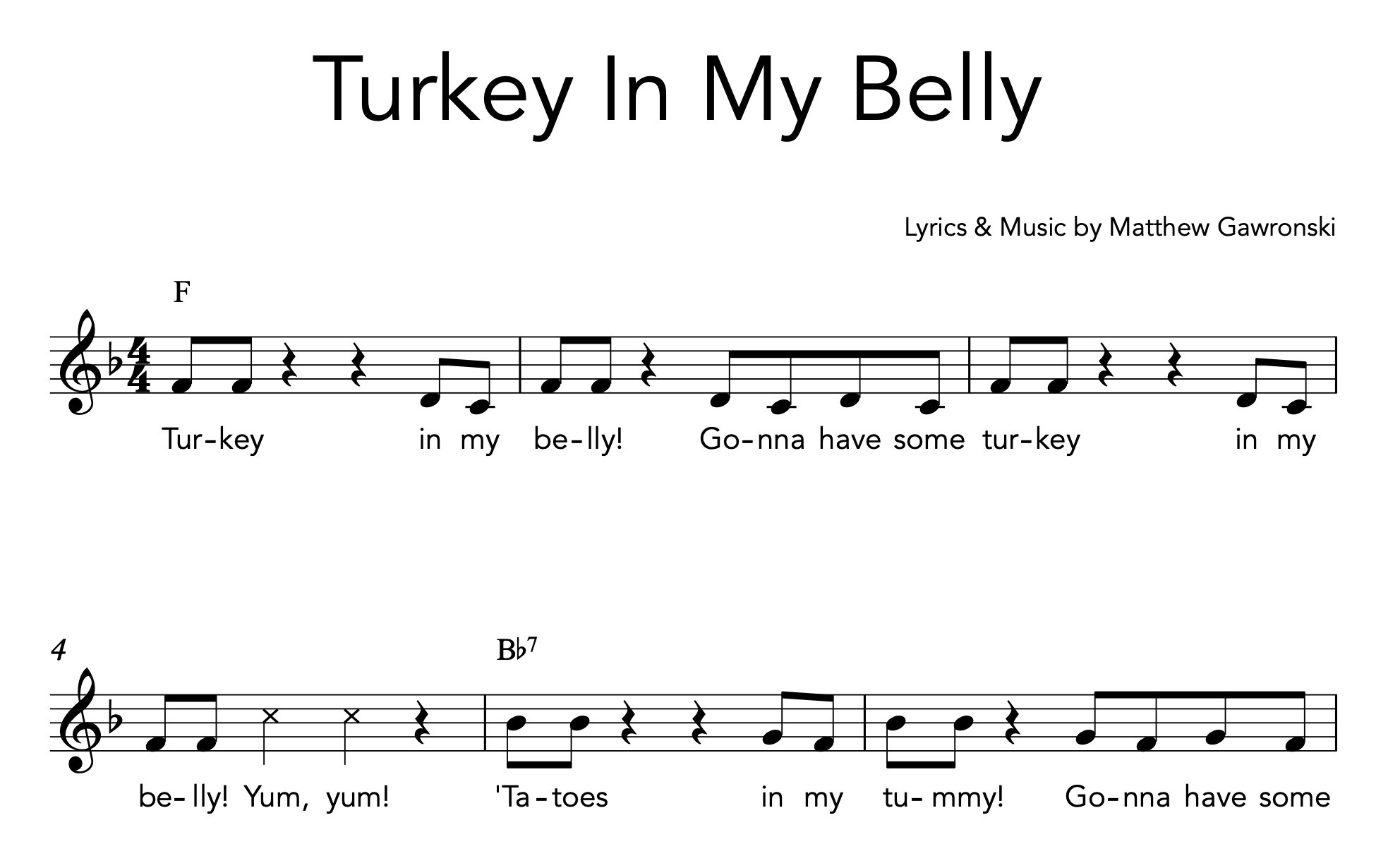
I wrote "Turkey In My Belly" (lyrics and music) when I taught that one year of elementary general music, and I still pull it out almost every November. It is a one-page reproducible PDF: a single melody line in F major and 4/4, 14 measures long, with chord symbols over the staff. The verses are all about the food ("Turkey in my belly!" and "'Tatoes in my tummy!"), each one answered by a shouted "Yum, yum!" written with x noteheads. Then the ending turns sweet: "But I'm thankful most of all for my friends and my family and my clothes and my shoes; I'm thankful for it all!"
Download the free Turkey In My Belly PDF here. You are welcome to copy it for your students.
Teaching notes for Turkey In My Belly
- Range: the whole song sits between middle C and the C an octave above, a comfortable range for young voices.
- Rhythm: it uses only eighth notes, quarter notes, quarter rests, one half note, and one dotted half note. Speak the words in rhythm first ("tur-key" is two eighth notes), then have students find those rhythms on the page.
- Solfege: the opening "Tur-key in my" is do, do, low la, low so. That makes it a fun way to practice low la and low so with second and third graders once they know the song by ear.
- Unpitched notation: the "Yum, yum!" x noteheads are a great first look at notation without pitch. Let students rub their bellies or pat their laps on those beats.
- Accompaniment: the chords on the page (F, B flat 7, C, G minor, F/A, and B flat) work on piano, guitar, or ukulele, and older students can play the melody on recorder or barred instruments.
A couple of years ago I recorded it as "The Turkey Song," and my niece was nice enough to add the dance moves. Your students can learn them from the video:
If you teach older students too, I use the same song as a silly, laugh-at-yourself sight-reading activity with my middle schoolers. I wrote up how I pair it with Thanksgiving speech rhythms in Music Class Activities for the Week of Thanksgiving.
Traditional Thanksgiving and harvest songs for elementary music
These are the songs I would reach for first in a K to 5 general music room, because you can teach them by ear with nothing but your voice. If your choir wants to perform one, I have linked a published arrangement where I could verify one on the publisher's page.
Over the River and Through the Wood
This one actually says Thanksgiving in it. The words are Lydia Maria Child's poem "The New-England Boy's Song about Thanksgiving Day," first published in 1844, and the tune is by an unknown composer. Some versions swap in "Hurrah for Christmas Day!", so check which words your source uses.
- Teaching notes: have students gallop or pat the steady beat like horses' hooves, then hand out jingle bells for the beat on the second verse. Older students can map the verses and make a "grandmother's house" travel map for the form.
- For choir:Over the River, arranged with new words and music by Andy Beck, is a 2-Part partner song from Alfred (00-27079). Singers learn the familiar tune, then a new melody, then put them together, which is a great first step into part singing. A SoundTrax CD is sold separately (00-27080). Alfred calls it "a wonderful wintertime selection," so it can stay on your winter concert too.
Come, Little Leaves
A traditional autumn song with words from a poem by George Cooper and a melody by Margaret P. Osgood. It is perfect for a fall program that does not need to be about the holiday itself.
- Teaching notes: give everyone a scarf and let the "leaves" float down on the falling phrases. It is a natural lesson on high and low and on melodic direction.
- For choir:Come, Little Leaves: A Fall Song for Elementary Choir, arranged by Joanna Mills (Joanna Mills Music, J.W. Pepper 11415810). J.W. Pepper lists it as a Two-Part octavo, and the description says it is arranged for unison elementary choir with call and response sections, echoes, a new bridge in E minor, and an ostinato ending with an optional harmony echo part. About 2 minutes.
Simple Gifts
The Shaker song from 1848, generally attributed to Elder Joseph Brackett. It is not a Thanksgiving song, but its message about simple, grateful living fits November beautifully.
- Teaching notes: teach the melody by rote, then listen to Aaron Copland's Appalachian Spring (written for Martha Graham's 1944 ballet) and have students raise a hand every time they hear the Simple Gifts tune come back. It is a perfect bridge from singing to listening.
Thanksgiving songs for choir: hymns and sacred anthems
If you direct a children's church choir, or your school is comfortable with sacred texts, these are the classic Thanksgiving hymns. Check your district's guidelines first. Many public school directors stick to the songs in the sections above and below.
- We Gather Together. A Dutch hymn written in 1597 by Adrianus Valerius. The tune is often called "Kremser," after Eduard Kremser's 1877 arrangement, and the English words most Americans know are Theodore Baker's from 1894. Teaching note: sing it in unison first, then share the history. Upper elementary students are always surprised that a song tied to an American holiday started in the Netherlands.
- Come, Ye Thankful People, Come. An English harvest hymn written in 1844 by Henry Alford, usually sung to the tune St. George's Windsor by George Job Elvey. Teaching note: a strong unison hymn for a harvest program, with a great chance to talk about what "harvest home" means.
- Now Thank We All Our God. Written around 1636 by Martin Rinkart in German ("Nun danket alle Gott") and translated by Catherine Winkworth, with the tune Johann Crüger published in 1647. Teaching note: pair it with the Liebergen canon below, which quotes this tune.
- Sing a Song of Thanksgiving, by Mark Hayes. Unison/2-Part Treble, Shawnee Press (Harold Flammer WorshipSongs Jr), HL 01438566, about 2:31. Hal Leonard says it was written for older elementary choirs and lists eight short expressions of gratitude from a child's point of view, with optional soloists or small groups on the "counting" phrases. Teaching note: this is a great one for giving several confident singers a short solo moment. It is scripture based, so it fits church choirs best.
Published octavos for an elementary Thanksgiving concert
- Simple Canon of Thanks, words and arrangement by Patrick M. Liebergen. 2-Part or 3-Part (any combination), Alfred 00-19034, with optional flute. Alfred describes unison and canonic sections built on the chorale tune "Nun danket alle Gott" and calls it wonderful for harvest or Thanksgiving. Teaching note: if your fourth and fifth graders have sung rounds like "Row, Row, Row Your Boat," this is a natural next step into independent part singing.
- Thankful, by Carole Bayer Sager, David Foster, and Richard Page, arranged by Mark Hayes. Recorded by Josh Groban. Shawnee Press, 2-Part HL 35029998 (also SATB, SAB, SSA, and TTB). Teaching note: at about 5:30 it is long for young singers, so I would save it for a strong fifth grade choir or a combined finale. Hal Leonard notes it works any time of year, including Christmas, so it can carry straight into your winter concert.
- Plus the two arrangements above: Andy Beck's Over the River (2-Part) and Joanna Mills' Come, Little Leaves.
Publishers change editions and stock, so check each product page for current availability, pricing, and minimum order quantities. And remember to buy one copy for each singer.
A Thanksgiving listening pick: Stuffy Turkey
"Stuffy Turkey" is a Thelonious Monk tune from his 1964 Columbia album It's Monk's Time. The title alone gets a giggle from second graders.
- Teaching notes: play the opening melody and have students show the steady beat with rhythm sticks or a pat, then freeze when the melody stops and the solos begin. Ask them to raise a hand when the melody comes back at the end. Then sing "Turkey In My Belly" and ask how the two turkey songs are different. That is a whole lesson on tempo, style, and form.
Keep the music reading going in November
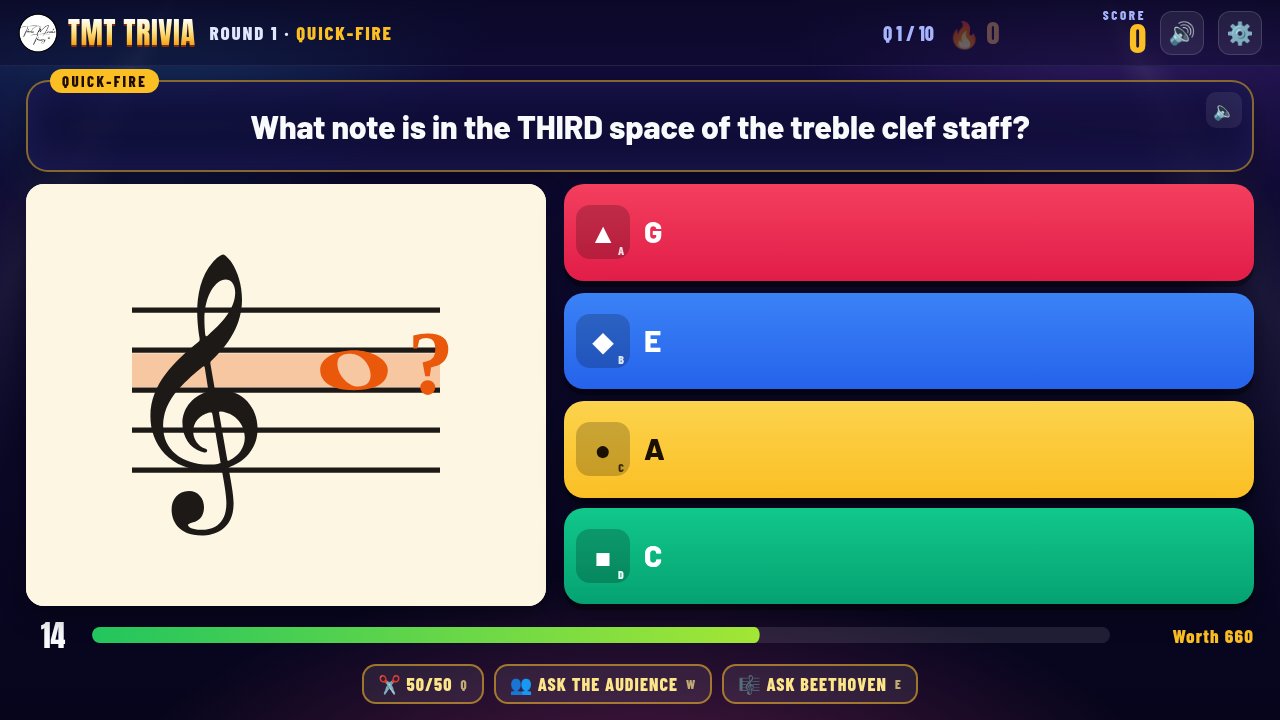
Thanksgiving songs are a great excuse to keep reading skills moving. Once your upper elementary students can name the notes in "Turkey In My Belly," give them a quick review game. On ThreeMinuteTheory.com, each chapter is a short video lesson followed by games, and when you assign a game you can choose Easy (elementary), Medium (middle school), or Hard (high school). Here is TMT Trivia playing Chapter 4, Reading Treble Clef Notes, the same skill your students use to find the F's and C's in the first line of the turkey song. For more short warm-up ideas, see these music theory bell ringers.
For rhythm, the speech rhythm approach in "Turkey In My Belly" pairs well with whatever counting system you use. SightReadQuest has a clear comparison of rhythm counting systems if you are deciding between Takadimi, Kodály ta and ti-ti, or Gordon du-de. And when your older singers are ready to read short melodies on their own, the 5-minute daily sight-reading routine for choir is an easy place to start.
Don't skip the warm-up, either. My self-guided choir vocal warm-up videos are made to project while you take attendance, and you will find more sight-singing activities and games on my choir resources page. When it is time to think about December, my choir sheet music page has reproducible choir PDFs in several voicings, including free Christmas downloads, and my music teacher tools page has full-period activities for the short week before break.
Frequently asked questions
What are good Thanksgiving songs for elementary music?
Start with songs you can teach by ear: "Over the River and Through the Wood," "Come, Little Leaves," and my free "Turkey In My Belly." Add "Simple Gifts" for a gratitude theme and Thelonious Monk's "Stuffy Turkey" for a listening lesson.
What are good Thanksgiving songs for choir?
For elementary choir, try Andy Beck's 2-Part "Over the River," Joanna Mills' "Come, Little Leaves," Patrick M. Liebergen's "Simple Canon of Thanks," and Mark Hayes' "Sing a Song of Thanksgiving." For a strong fifth grade or combined choir, Mark Hayes' 2-Part arrangement of "Thankful" is a longer option.
Are there Thanksgiving songs for school that are not religious?
Yes. "Over the River and Through the Wood," "Come, Little Leaves," "Turkey In My Belly," and "Stuffy Turkey" are all about the holiday, the season, or the food. The hymns and anthems in the sacred section are best for church choirs or schools that welcome sacred texts.
Is Turkey In My Belly really free?
Yes. It is a free, reproducible one-page PDF. Download it here and make as many copies as your class needs.