Every fall I watch the same thing happen in my 7th and 8th grade choirs. A kid who sang a confident alto line in September opens his mouth in October and a squeak comes out, followed by a note an octave lower, followed by a very red face. A few rows over, one of my sopranos suddenly sounds breathy and can't find the top of her range. Neither of them is doing anything wrong. Their voices are changing, and the way we run warm-ups can either make that season feel normal or make them want to quit choir.
Most of what you find when you search for warm ups for changing voices is research papers and journal articles. They don't tell you what to do at 8:02 on a Tuesday when 45 middle schoolers walk in. This post is the practical version: the rules I follow, a 10-minute warm-up sequence you can steal, how I talk to students about cracking, and the resources I lean on when I want warm-ups that run themselves.
What is actually happening to a changing voice
You don't need to be a voice scientist to teach changing voices well, but it helps to know the basics so you can explain them to students.
- Boys: the larynx grows and the vocal folds get longer and thicker. Over a year or two the speaking and singing voice drops, sometimes a full octave. In the middle of that change the usable range can get very narrow, and the voice can flip unpredictably between a lighter upper sound and a new lower sound. That flip is the "crack."
- Girls: the change is less dramatic but very real. Many girls go through a stretch where the tone gets breathy or husky, the voice cracks around the middle of the range, and high notes that used to be easy feel unreliable.
The key idea for students: this is temporary, it happens to everyone, and the singers who keep singing gently through it usually come out the other side with a stronger voice.
If you want the longer version, here is a presentation I gave for the Alabama Vocal Association called "Navigating the Changing Voice." I walk through how I think about the male changing voice (I describe it in terms of "vocal gravity") and the strategies I use with my own middle school choirs.
Five rules for warm-ups with changing voices
1. Start in the middle, not at the top
Plenty of classic warm-ups start high and descend, or climb by half steps until someone squeaks. For a changing-voice choir, start every pattern in a comfortable middle key and only move a few steps in either direction. If you would normally go up six half steps, go up two.
2. Let singers switch octaves freely
Make it a standing rule: "If a pattern gets too high or too low, drop or jump the octave and keep going." A boy singing an octave below the sopranos is still matching pitch. Say that out loud often, because many students think they are "wrong" when they sing in a different octave.
3. Keep it light and short
Changing voices tire faster. I aim for gentle volume (think mezzo piano), lots of short patterns, and no long sustained notes at the edges of the range.
4. Use slides and sirens to connect the registers
The crack happens at the break between registers. Gliding through that break on a lip trill or a gentle "oo" teaches the voice to cross it smoothly instead of avoiding it.
5. Group by current range, not by label
During warm-ups I care about where each voice is today. A student might be a tenor in October and a baritone in February. Seat and assign parts based on what you hear, and check again often.
A 10-minute warm-up sequence for changing voices
Here is the sequence I use most days with middle school choirs. Adjust keys to your group, but keep the order.
Step 1: Body and breath (2 minutes)
Stretch shoulders and neck, then do a few rounds of "inhale for 4, hiss for 8," then "inhale for 4, hiss for 12." Every voice can succeed at breath work, so it builds confidence before anyone sings a pitch.
If you would rather project a guided version, my short Stretches for Vocalists video walks the whole choir through stretches to use before singing.
Step 2: Lip trills and sirens (2 minutes)
Lip trill on a comfortable pitch, then slide up a little and back down. Next, sirens on "oo," starting in the middle and floating upward, then sighing back down. Tell boys whose voices are changing to let the voice "flip" into a lighter sound at the top if it wants to. That lighter upper voice (head voice or falsetto) is healthy and worth keeping alive.
Step 3: Descending five-note patterns (2 minutes)
Sing sol-fa-mi-re-do on "oo" or "noo," starting in a key where most of the room is comfortable, and move down by half steps rather than up. Descending patterns bring head voice down into the middle range, which is exactly where cracking voices need help. Remind everyone they can sing it in whatever octave works.
Step 4: Vowel shaping (1 to 2 minutes)
Move through "oo, oh, ah" on a single comfortable pitch with a tall, relaxed mouth shape. Rounded vowels are more forgiving for breathy or unstable voices than bright "ee" and "eh" vowels, so start there and add brighter vowels later in the year.
Step 5: Articulation (1 minute)
Speak and then sing a short pattern twice: once staccato, once legato. Articulation drills are great for changing voices because they focus attention on the mouth and the breath instead of on range.
Step 6: Pitch matching and tuning (2 minutes)
Play or sing a pitch and have students echo it, then build a simple chord (do, mi, sol) with voices split by current range. Praise octave matches loudly. For a quick one-on-one check, my free Note Namer shows each singer the note they are singing on a staff.
See a full warm-up in action
Here is a free, self-guided choir warm-up video you can project. It starts with pulsing rhythms on a "sh" sound, moves into octave lip trills (students who can't trill can hum or sing "oo" instead), and then works through vowels. It is a great one to use on a day when you want to walk the room and listen to individual voices.
How to talk about cracking (so nobody quits)
The single biggest thing you can do for a changing voice is to make cracking boring. When a voice cracks during warm-ups, I don't stop, I don't make a face, and I don't let the room react. Early in the year I tell every class something like this:
"Every voice in this room is going to change at some point, and every voice that changes cracks. When it happens, it means your instrument is growing. Keep singing gently, switch octaves if you need to, and keep going. Nobody laughs in here, because it is going to be your turn too."
I also give my changing-voice singers a private job: "If a note is out of reach, sing it an octave lower, or just mouth the words for that note and come back in." Having a plan takes away the panic. It is worth the effort, because the benefits of music education grow the longer students stay in music.
Check ranges often and adjust parts
A quick range check every six to eight weeks saves a lot of frustration. Each student sings a short descending scale from a comfortable starting pitch and a short ascending scale, and I jot down the lowest and highest comfortable notes. That data tells me who needs a part change before a concert, not after.
Repertoire matters too. Middle school choirs with changing voices usually do best in voicings like unison, 2-part, 3-part mixed, or SAB, where the lower part sits in a narrow, comfortable range. If you are looking for reproducible music in those voicings, my choir sheet music page has PDFs in unison, 2-part, 3-part mixed, SAB, SSA, and SATB voicings.
When video warm-ups make your life easier
There are seasons when I want warm-ups that run themselves so I can walk around, listen to individual voices, and quietly help the kid whose voice just dropped. That is exactly why I made my choir vocal warm-up videos. A few that fit changing-voice choirs especially well:
- The Classical Collective Choir Vocal Warmup Package: 5 warm-up videos built on melodies by composers like Bach, Beethoven, Chopin, and Mozart, targeting breath control, vowel formation, and diction. It features a male vocal lead, which helps your boys hear a lower voice modeling the pattern and encourages them to project their own voice. Each video comes with a reproducible PDF.
- The "Actually-Fun" Vocal Warmup Series (also called the Epic Vocal Warmup Video Series): 5 warm-up videos plus reproducible PDFs, with backing vocals from the voices of the Eric Whitacre Choir, built to get singers to confidently project and sing out. It includes a teacher license for in-person and online sharing.
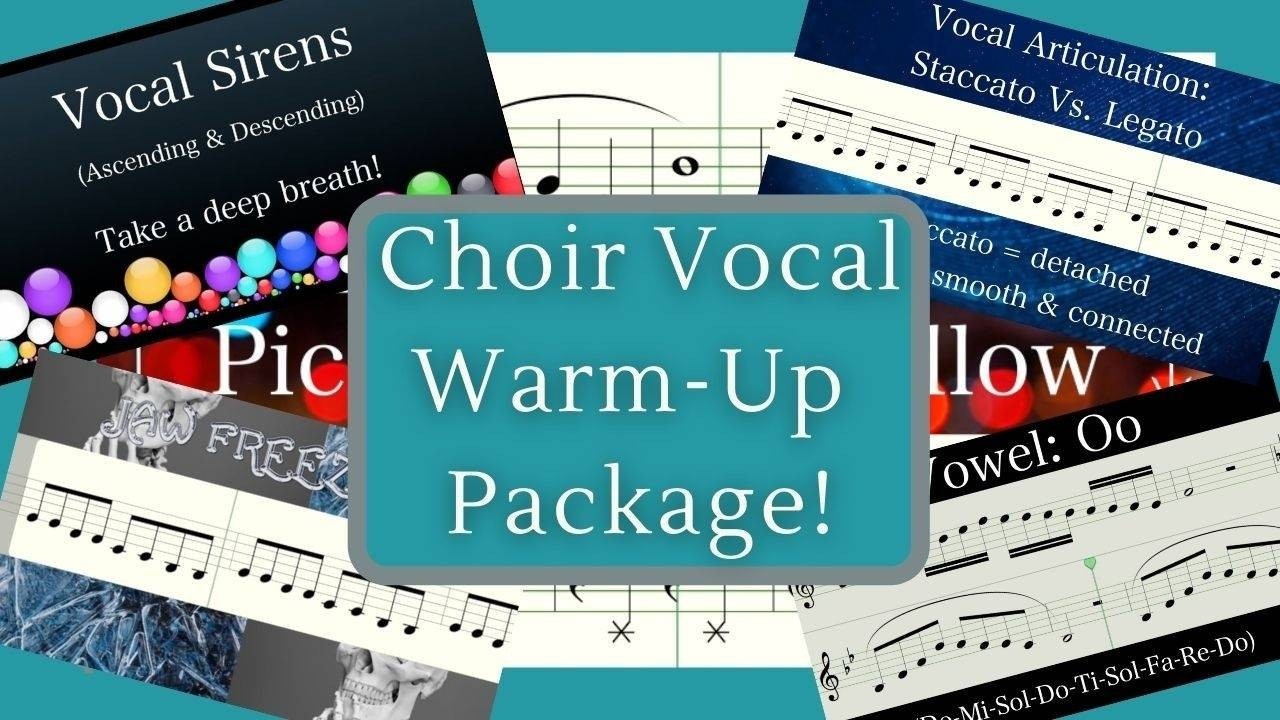
- The Choir Vocal Warmup Video Package: all 5 of my original choir warm-up videos in one discounted package, with nearly 30 minutes of total warm-up run time.

Here is one of the Classical Collective warm-ups, so you can hear what it sounds like before you use it with your choir:
One choir director, Nathan, told me he used the first video while being observed and loved that it let him take roll and move around the choir giving notes instead of being stuck behind the piano. That freedom is the real value with changing voices, because you can stand next to the student who is struggling.
If you are wondering whether a paid set is worth it compared to free videos, I wrote an honest comparison: Epic Vocal Warmups vs free YouTube warm-ups. Short version: YouTube wins on price, and a packaged set wins when you are tired of rebuilding a playlist every August.
After warm-ups: build reading skills in every range
Warm-ups are only the start of rehearsal. Two tools I built pair well with changing voices:
- ThreeMinuteTheory.com: press play after warm-ups and teach a lesson that lasts about 3 minutes, with no student login needed to project. It includes a Choir Volume, and the Audiation Arcade game Pitchy Bird is a pitch-matching game with a voice picker (Soprano, Alto, Tenor, Baritone, Bass), so a newly low voice can play in a range that fits.
- SightReadQuest: students sing into the mic and get graded on pitch and rhythm automatically. Music Tools next to the staff include Play Tonic and key or octave transpose, which is a big help when a student's range is moving under them.
FAQ: warm ups for changing voices
How long should warm-ups be for middle school changing voices?
About 8 to 12 minutes is plenty. Changing voices tire faster, so keep patterns short, volume moderate, and save energy for repertoire.
Should boys with changing voices sing in falsetto?
Yes, gently. Light sirens and slides into the upper voice keep it flexible and help connect the registers. Just never push for volume up there.
Is it okay for students to sing an octave lower during warm-ups?
Absolutely. Octave displacement is still matching pitch. Make it an official classroom rule so nobody feels like they are doing it wrong.
Do girls' voices change too?
Yes. Many middle school girls go through a breathy, unstable stretch with cracks in the middle of the range. Use the same gentle, middle-range approach for them.